Living With Early Dragonflies

The Common Whitetail Dragonfly, Libellula lydia, is living up to its name this year: “Common”. These dragonflies have a long activity period. They can be active in Indiana as early as April and some are still flying late into September and early October. They rest on the ground to hunt for prey. They blend well with the surroundings and are difficult to spot. A passing hiker is usually unaware of the dragonfly until a too close approach causes the dragonfly to take flight.

WhiteTailDragonfly.001Like most dragonflies, the Common Whitetail is territorial and will return to its favorite resting spot. To observe a dragonfly, wait motionless near where the dragonfly was resting. Often the dragonfly will return to its previous spot.

The Whitetail Dragonfly chooses a resting spot in a favorable location to hunt prey. The Whitetail Dragonfly is a faster flyer and can gain altitude more rapidly than its prey. By resting on the ground and flying up to meet its prey, the dragonfly cuts off the ability of its prey to escape by diving rapidly to the ground.

Posted in behavior, by jjneal, Environment | 1 Comment

Living With Puddles

A mud puddle (or soil wet with irrigation water) is attractive to many butterflies. The butterflies at these sites are males that are collecting sodium to supplement the caterpillar diet (plants) which is deficient in sodium. Water dissolves minerals in the soil. Minerals, including sodium concentrate as the water evaporates. A male will transfer the sodium it collects to a female during mating. The sodium is necessary for the offspring.

Why do females not collect their own sodium? Several factors may be involved. Butterflies on the ground can be attacked by predators. Females have extra nutrients to provision their eggs making them slightly heavier and slower to take flight. The reproductive system of females occupies a larger volume of the abdomen leaving less room to collect and process larger volumes of water.

Black Swallowtail Drinks From Mud Puddle

Black Swallowtail Drinks From Mud Puddle

Posted in Environment, behavior, by jjneal | Leave a comment

Living With Large Carpenter Bees

Carpenter Bees Entering a nest (above) and exploring territory (below)

Carpenter Bees Entering a nest (above) and exploring territory (below)

The Horticulture Department at Purdue University maintains Horticultural Gardens surrounding its main building. The gardens are a great place to observe insects including butterflies, bees and other pollinators. Recently, they added a wooden structure that provides shade in the middle of the garden. It also provides excellent habitat for Large Carpenter Bees. The bees, which resemble bumblebees can be seen hovering around the structure and flying in and out of the entrance holes. The males will guard territory and engage with other male carpenter bees.

The Carpenter Bees do minor damage in the first generation. However, subsequent generations will enlarge the brood chambers and can do considerable structural damage. The structure will probably be treated to eliminate the Carpenter Bees. In the meantime, it is a great location to observe their behavior.

Posted in behavior, by jjneal, Pest Management | Leave a comment

Living With Invasive Ants

Texas has a new ant in town: the crazy ant. Crazy ants are natives of Brazil that have been inadvertently transported to North America, first noted in Houston, Texas in 2002. Crazy ants will likely displace many native (and non-native) ant species.

Good News: Crazy ants don’t sting like Fire Ants; Crazy ants can displace Fire Ants that deliver a painful sting and even kill livestock.

Bad News: Crazy ants can displace Fire Ants. Fire Ants have become an important component of ecosystems including agricultural ecosystems. Some pests controlled by Fire Ants may require other methods of control.

More Bad News. Fire Ants only nest outdoors. Crazy Ants nest everywhere including human structures. Homeowners have reported large indoor colonies that are difficult to eliminate.

AllisonB shares her videos of Crazy Ants versus Fire Ants (Embed below). Fire Ants do not effectively defend against Crazy Ants. Crazy Ants effectively attack Fire Ants both on offense and defense. Crazy Ants will expand their territory one Fire Ant at a time.

Posted in behavior, by jjneal, Environment, Invasive Species | 3 Comments

Friday Cat-erpillar Blogging: Toxic Caterpillars

The Oak Processionary Moth, Thaumetopoea processionea, has been expanding its range. A native of Southern and Central Europe, the moth has expanded into the Netherlands, Belgium and Northern Germany. Why is its range expanding? One factor is movement of plants from infested areas to uninfested areas. Climate change, warmer temperatures during the Spring development period, may be a factor. In 2006, Oak Processionary Moth was shipped to England on oak trees from Europe. The caterpillars are thriving in their new home, posing a threat to oak trees and human health.

Thaumetopoea processionea in procession around an oak tree

Thaumetopoea processionea in procession around an oak tree
Photo RJA Meijer

The caterpillars have urticating hairs containing an allergenic protein, thaumetopoein. People can have allergic reactions from contact with the hairs ranging from mild to anaphylaxis. The hairs are lightweight and can become airborne. Disturbing a caterpillar nest is hazardous.

In their native area, cultural knowledge of the need to avoid the caterpillars is widespread. In their new home, the public is unfamiliar with this new caterpillar and may be unaware of the hazards. The combination of an unaware public and caterpillar outbreak is a bad mix. The UK government has launched an education campaign that is more intensive near infested areas. In outbreak areas, sprays to reduce the populations may be recommended to protect the oak trees and the public. This year, the UK will spray some forested areas with Bt toxin (a caterpillar specifici toxin) to control some outbreak populations.

Posted in Biomaterials, by jjneal, Caterpillar Blogging, Education, Environment, Health, Invasive Species, Pest Management | Leave a comment

Living With Mate Guarding

Cricket

Cricket

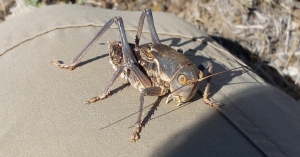
In many cricket species the male transfers nutrients to the female during mating. Females who mate with multiple males can produce more eggs. However, a male will produce the most eggs if all his sperm fertilize the eggs of the female. Male crickets package their sperm in a structure called a spermatophore. Once it is attached to the female, the sperm must leave the spermatophore to fertilize the eggs. This process requires time. Females will remove and consume the nutrient-rich spermatophore. How can the male protect his sperm? Males engage in a behavior known as mate guarding.

After mating, males will remain in contact with the female for an extended period. Male house crickets, Acheta domesticus, will remain with the female for about 30 minutes, maintaining antennal content and blocking the female from prematurely removing the spermatophore. Males of the decorated cricket, Gryllodes sigillatus, transfer a gelatinous spermatophylax in addition to the spermatophore. The female first consumes or discards the spermatophylax before removing the spermatophore. Females will spend more time consuming more nutritious spermatophylaxes, giving the male sperm more time to leave the spermatophore.

Posted in behavior, by jjneal | Leave a comment

Battling Invasives

We hear most often about the invasive species that overwhelm all our efforts to halt their spread and takeover. There are some instances of success. The Asian Longhorned Beetle, Anoplophora glabripennis, is a native of China that attacks hardwoods. The successful eradication from Manhattan Island, New York was announced in May 2013.

Asian LongHorned Beetle

Asian Longhorned Beetle
Image: Donald Duerr, USDA Forest Service, Bugwood.org

The Asian Longhorned Beetle was first detected in North America in Brooklyn, NY in 1996. Later it was detected in Chicago, IL in 1998, several counties in New Jersey between 2002 and 2004 and in the area around Worcester, MA between 2008 and 2010. Compared to other invasive beetle pests, the Asian Longhorned Beetle is larger, does not spread rapidly and increases its population more slowly. Its biology is amenable to eradication efforts. Asian Longhorned Beetle has been eradicated from Chicago; New Jersey was declared beetle free in April 2013; As of May 2013, it has been eradicated from Manhattan Island in New York where it threatened trees in Central Park.

Eradication is expensive, labor intensive and time consuming. However, eradication, once achieved reduces the need for future inspections and control efforts. Eradication requires that all trees in the area be extensively surveyed for signs of the beetle. Surveys often require tree climbers to inspect the upper reaches of trees for signs of beetle damage. Insecticide treatments can prevent nearby trees from becoming infested, however, the insecticides are not as effective against large beetle larvae. Those beetles must be controlled by destruction of the tree that harbors them, sometimes to the consternation of homeowners. The beetles migrate a limited distance of less than one mile per year. This delimits the initial area for eradication.

Eradication is cost effective compared to the potential damage this beetle could cause. Even more cost effective are efforts to prevent the entry of invasive species into North America.

Posted in by jjneal, Environment, Invasive Species, Pest Management | Leave a comment